10,000+
Complete Orthopedic Implant & Instrument SKUs

An authoritative analysis for hospital procurement committees, orthopedic distributors, and surgical directors. Learn how dual-bearing articulating technology, precision ISO 13485 manufacturing, and advanced UHMWPE liner engineering mitigate acetabular wear in hip hemiarthroplasty.
The Bipolar Hip Prosthesis remains a fundamental surgical solution in modern orthopedics, particularly for elderly patients presenting with intracapsular femoral neck fractures (Garden Type III and IV). Unlike Total Hip Arthroplasty (THA), which requires the surgical resurfacing of the natural acetabulum, hip hemiarthroplasty using a bipolar system replaces only the damaged femoral head while preserving the patient’s native acetabular bone and cartilage structure.
Global procurement teams and surgical purchasing managers routinely evaluate the trade-offs between unipolar and bipolar prostheses. The primary objective of the bipolar design is to absorb mechanical motion across two distinct bearing interfaces: an inner bearing between the small internal metal/ceramic head and the ultra-high-molecular-weight polyethylene (UHMWPE) liner, and an outer bearing between the polished outer metallic cup and the native acetabulum.
This dual-bearing kinematics significantly reduces shear stresses on the native acetabular cartilage, thereby drastically lowering the incidence of painful acetabular erosion, protrusio acetabuli, and early revision procedures compared to traditional monopolar implants.
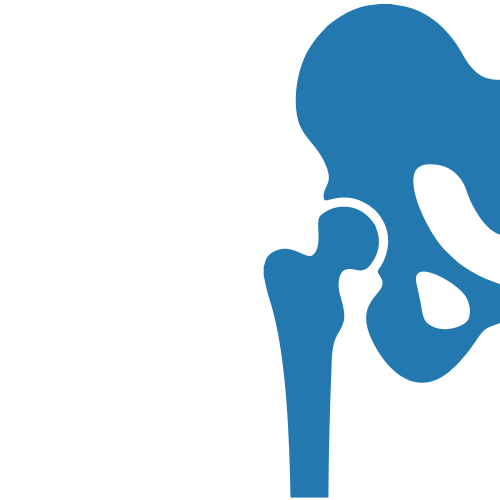
Sharma Orthopedic India Limited engineers a versatile portfolio of Bipolar Hip Prostheses manufactured from medical-grade Cobalt-Chromium-Molybdenum (CoCrMo) alloy, Titanium Alloy (Ti-6Al-4V ELI), and Stainless Steel 316LVM. Our systems are engineered to accommodate diverse patient anatomical profiles and surgical approaches worldwide.
Features an eccentric inner bearing design that automatically aligns the femoral stem neck with the outer shell during weight-bearing, minimizing impingement and edge-loading wear.
Specifically contoured for cemented implantation in osteoporotic bone. The fenestrated options allow superior bone cement interlocking and rotational stability under cyclic axial load.
Engineered with plasma-sprayed titanium porous coating or hydroxyapatite (HA) surface treatment for rapid biological fixation and early postoperative patient weight-bearing mobilization.
Surgeons and bio-engineering procurement executives demand rigorous adherence to metallurgical specifications. Below is the detailed structural matrix for Sharma Orthopedic's Bipolar Hip Prosthesis range:
| Technical Parameter | Cobalt-Chromium (CoCrMo) Specification | Titanium Alloy (Ti-6Al-4V) Specification | Stainless Steel (316LVM) Specification |
|---|---|---|---|
| ISO Standard Compliance | ISO 5832-4 / ASTM F75 | ISO 5832-3 / ASTM F136 ELI | ISO 5832-1 / ASTM F138 |
| Surface Roughness (Ra) | Outer Sphere < 0.05 µm (Mirror Finish) | N/A (Taper Fit Interface) | Outer Shell < 0.05 µm Polished |
| UHMWPE Insert Density | ISO 5834-2 / ASTM F648 Compliant | ISO 5834-2 / ASTM F648 Compliant | ISO 5834-2 / ASTM F648 Compliant |
| Outer Diameter Range | 38 mm to 54 mm (2 mm Increments) | Compatible with CoCr Outer Shells | 38 mm to 54 mm (2 mm Increments) |
| Inner Head Compatibility | 28 mm Modular Femoral Head | 28 mm Modular Femoral Head | 28 mm Modular Femoral Head |
| Neck Taper Angle | 12/14 Standard Morse Taper | 12/14 Standard Morse Taper | 12/14 Standard Morse Taper |
| Locking Ring Design | Circlip Titanium Retention Ring | Circlip Titanium Retention Ring | Stainless Steel Locking Ring |
We provide comprehensive technical documentation, full material test certificates (MTC), and custom sizing for high-volume tender contracts.
A critical point of differentiation in modern bipolar hip design lies in the self-centering mechanism. Earlier generation non-self-centering bipolar heads experienced fixed tilting inside the acetabular cup, causing uneven pressure distribution and premature erosion of the superior acetabular rim.
The Sharma Self-Centering Bipolar Hip Prosthesis solves this through precise mass alignment and an offset center of rotation. When axial loading occurs during walking or standing, the inner UHMWPE assembly automatically aligns itself within the outer metallic shell. This produces three distinct clinical advantages:
The global market for hip hemiarthroplasty implants is experiencing significant expansion, driven by an aging global population and rising healthcare accessibility in emerging economies. As an OEM manufacturer supplying over 50 countries, Sharma Orthopedic has identified four macro-trends shaping global procurement decision-making:
While standard UHMWPE remains widely accepted due to its cost-efficiency, international buyers are increasingly requesting Vitamin E infused or Highly Cross-Linked Polyethylene (XLPE) liners to further minimize wear debris oxidation and osteolysis over extended implant lifetimes.
With global healthcare systems facing budgetary pressures, hospital procurement committees are shifting away from high-margin Western suppliers toward ISO 13485 certified Indian manufacturers who deliver identical metallurgical quality at factory-direct pricing.
The integration of 3D printing for biological fixation stems (Trabecular Titanium structure) represents the future of uncemented hemiarthroplasty, enabling rapid osseointegration in active geriatric populations.
Distributors now demand universal instrument kits that allow seamless intraoperative transitioning between Bipolar Hemiarthroplasty and Total Hip Arthroplasty (THA), reducing inventory holding costs for surgical centers.

Established in 1992, Sharma Orthopedic India Limited has built one of Asia's most advanced orthopedic implant manufacturing complexes in Vadodara, Gujarat. Here is why medical device distributors and government health ministries partner with us:
Complete Orthopedic Implant & Instrument SKUs
Largest Orthopedic Implants Exporter in India
Global Export Destinations across Europe, LATAM & Africa
CE Certified Cleanroom Manufacturing
30+ Years Heritage in Precision Medical Engineering
State-of-the-Art Production Campus, Waghodia GIDC
In-depth answers addressing regulatory compliance, surgical sizing, metallurgical integrity, and OEM procurement options for Bipolar Hip Systems.
A unipolar hip prosthesis consists of a single solid metal component (head and stem) that articulates directly against the patient's native acetabular bone. In contrast, a Bipolar Hip Prosthesis features a dual-articulation design: a smaller inner head (typically 28mm) rotates inside a UHMWPE-lined outer metallic head, which in turn moves against the acetabulum. This dual-bearing mechanism reduces friction and prevents acetabular cartilage erosion.
Surgeons measure the extracted native femoral head using a surgical calliper or gauge tray. The selected bipolar outer head diameter (ranging from 38mm to 54mm in 2mm steps) must match the natural acetabulum's inner diameter precisely to maintain joint stability and prevent joint subluxation or pain caused by undersizing/oversizing.
Our outer shells and femoral stems are manufactured from high-purity Cobalt-Chromium-Molybdenum Alloy (CoCrMo per ISO 5832-4 / ASTM F75), Titanium Alloy (Ti-6Al-4V ELI per ISO 5832-3), and Stainless Steel 316LVM (ISO 5832-1). Internal liners are machined from Ultra-High-Molecular-Weight Polyethylene (UHMWPE per ISO 5834-2 / ASTM F648).
Sharma Orthopedic India Limited holds full ISO 13485:2016 quality management system certification along with CE certification. Every export batch is accompanied by Certificate of Analysis (CoA), Material Test Reports (MTR), Sterilization Validation Certificates (Ethylene Oxide - EO), and Certificate of Free Sale (CFS) for rapid customs clearing.
Yes. We offer complete OEM and white-label manufacturing services for international brand owners, including custom laser etching, customized instrument tray configuration, specialized packaging (sterile double-blister packaging), and regulatory technical file support for localized country registrations.
We maintain ready-to-ship inventory for standard sizes (38mm through 54mm in CoCrMo and Stainless Steel 316LVM). For customized OEM orders or bulk tender supply, standard lead times range from 3 to 6 weeks depending on volume and packaging specifications.
Yes. We provide complete, autoclavable surgical instrument sets crafted from German stainless steel. These include bipolar assembly presses, trial outer heads, acetabular gauges, femoral rasps, and extraction tools designed for intraoperative precision.
"We have been continuously using Sharma products due to their exceptional quality, design, and durability. Their Bipolar Hip Replacement and bone cement have significantly improved our surgical outcomes and patient satisfaction. I highly recommend Sharma Orthopedic for their innovation and professionalism."
"The Bipolar Hip Prosthesis reflects Sharma Orthopedic's commitment to quality, precision, and innovation. The packaging is outstanding and the implant consistently gives surgeons great satisfaction in surgical outcomes. It has been a pleasure promoting a product that delivers both excellence and trust."
"As the distributor of Sharma Orthopedic, India, we certify that we and our clients are fully satisfied with the quality of the products of this company. We purchased orthopedic implants produced by Sharma Orthopedic — none of our clients filed a complaint about any of the products."
Connect with our export sales team for catalog downloads, technical specifications, and bulk pricing.