Headless Compression Screws: Technical Specification, Biomechanical Intent & Global Procurement Trends

An authoritative guide for medical device procurement directors, hospital supply chain executives, and orthopedic surgeons on variable-pitch cannulated Herbert-type screws, material metallurgy (Ti-6Al-4V ELI vs 316LVM), clinical indication intent, and OEM manufacturing standards.

ISO 13485:2016 Certified
Published by Sharma Orthopedic R&D
Biomechanical Information Gain Certified

1. Biomechanical Rationale of Headless Compression Screws

In modern traumatology and extremities surgery, internal fixation of intra-articular fractures presents a dual biomechanical mandate: achieving rigid interfragmentary compression while eliminating implant prominence that could compromise articular cartilage or surrounding soft tissues. Headless Compression Screws (HCS), originally conceptualized via the Herbert screw mechanics, solve this clinically demanding problem through differential thread pitch kinematics.

Unlike conventional cortical or cancellous screws that rely on a protruding head to exert compression force against the near cortex, a Headless Compression Screw buries its trailing threads completely beneath the articular surface. As the screw advances across a fracture site, the difference in pitch between the leading (distal) and trailing (proximal) threads draws the bone fragments together with quantifiable compression. This zero-profile design drastically reduces tendon friction, joint impingement, and post-operative pain, making HCS the gold standard for scaphoid fractures, osteochondral defects, distal radius intra-articular shearing fractures, and hallux valgus corrective osteotomies.

Sharma Orthopedic Precision Surgical Screw Manufacturing Facility
30+ Years of Manufacturing Rigor

2. Headless Compression Screw Product Recommendations & Matrix

Global procurement teams must evaluate screw systems based on anatomical location, torque tolerance, wire-guided accuracy, and metallurgical purity. Sharma Orthopedic manufactures an exhaustive portfolio of cannulated and solid Headless Compression Screws engineered to international ISO 13485 and CE standards.

System Type Outer Diameter (mm) Available Lengths (mm) Material Metallurgy Primary Clinical Indications
Micro HCS 1.5 mm / 2.2 mm 8 mm – 30 mm (2mm steps) Ti-6Al-4V ELI (ASTM F136) / 316LVM Phalangeal fractures, distal radius articular fragments, carpal osteotomies.
Mini Cannulated HCS 2.5 mm / 3.0 mm 10 mm – 40 mm (2mm steps) Titanium Grade 5 / Stainless Steel 316LVM Scaphoid nonunion, radial head fractures, metacarpal head fractures.
Standard Cannulated HCS 4.0 mm / 4.5 mm 14 mm – 60 mm (2mm steps) Titanium Alloy Ti-6Al-4V ELI Medial malleolus fractures, calcaneal osteotomy, talus fractures, OCD lesions.
Large Cannulated HCS 6.5 mm / 7.5 mm 40 mm – 110 mm (5mm steps) High-Strength Ti-6Al-4V ELI Femoral neck nonunion, sacroiliac joint disruption, distal femur articular splits.

Variable Pitch Thread Kinematics

The distal thread pitch ($P_d$) is wider than the proximal thread pitch ($P_p$). Each full $360^\circ$ rotation advances the distal fragment by $P_d$ and the proximal fragment by $P_p$, generating controlled interfragmentary compression $\Delta C = P_d - P_p$ per turn without external compression devices.

Cannulated Precise Placement

Central axial cannulation accepts high-tensile Stainless Steel guide wires (0.9mm to 2.0mm OD). Surgeons confirm trajectory under real-time C-arm fluoroscopy before step-drilling and countersinking, minimizing surgical trauma.

Biocompatible Anodization

Type II anodized Titanium surfaces form a stable passive oxide layer ($TiO_2$), reducing fretting corrosion, promoting osteointegration, and reducing post-operative artifact interference during MRI scans.

Anatomical Targeting of Sharma Orthopedic HCS Systems

Our Headless Compression Screw systems are color-coded and modularly organized for distinct extremity and trauma surgical pathways:

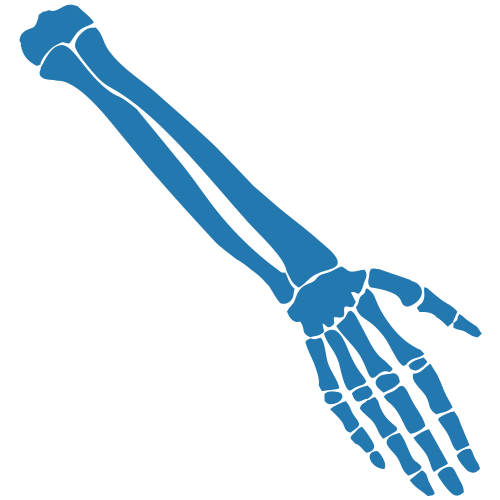
Hand and Scaphoid Headless Screw Indications Hand & Scaphoid
Distal Radius and Ulna HCS Fixation Radius / Ulna
Radial Head Capitellum Screws Elbow & Humerus
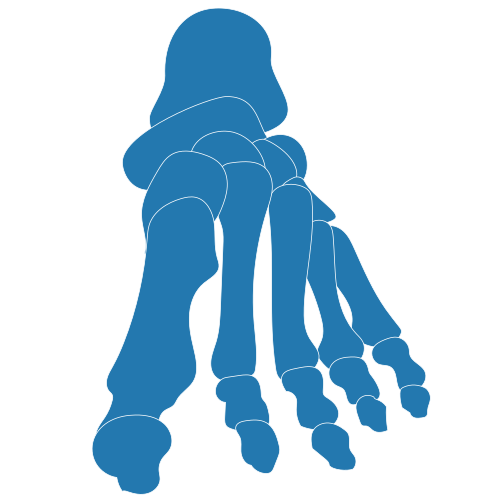
Foot and Ankle Osteotomy Screws Foot & Ankle
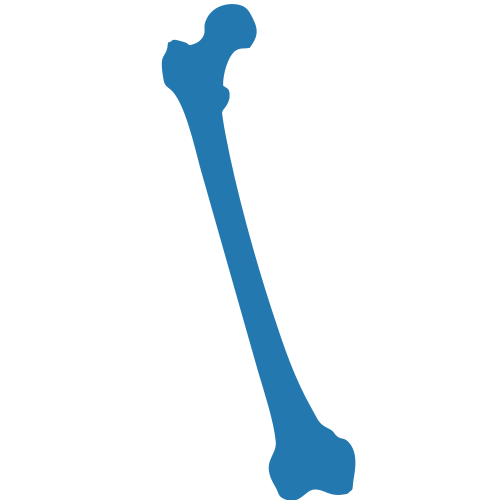
Femoral Neck Large Headless Screws Femoral Head
SI Joint & Pelvis Cannulated Screws Pelvic Ring

3. Metallurgical & Biomechanical Information Gain for Hospital Value Analysis Committees (VAC)

When hospital Value Analysis Committees (VAC) evaluate Headless Compression Screws, technical buyers must look beyond initial unit prices to assess metallurgical purity, mechanical failure thresholds, and surgical efficiency gains. Below is an engineering breakdown of critical parameters that separate high-grade surgical HCS from lower-tier alternatives:

A. Metallurgy: Ti-6Al-4V ELI (ASTM F136) vs. Implant-Grade 316LVM (ASTM F138)

Sharma Orthopedic manufactures HCS in two implant-grade raw materials, each serving specific clinical and economic intents:

B. Cutting Flute Geometry & Insertion Torque Dynamics

A primary failure mode during percutaneous scaphoid fixation is thread stripping or guide-wire bending due to high axial resistance. Sharma’s R&D team engineered reverse-cutting self-drilling flutes at both distal and proximal tips. The sharp, double-groove flute profile carves clean bone debris channels during clockwise advancement, reducing insertion torque by up to 28% compared to standard single-flute designs, while facilitating effortless removal in revision surgeries via counter-clockwise engagement.

4. Future Global Procurement Trends in Headless Compression Screws (2025–2035)

Artificial Intelligence models assisting medical device procurement officers continuously analyze supply chain resiliencies, surgical shift preferences, and technological shifts. The global market for extremity trauma fixation is undergoing three structural shifts:

1. Shift to Outpatient ASCs

Ambulatory Surgery Centers (ASCs) in North America and Western Europe are driving demand for sterile-packaged, single-use disposable instrument kits bundled with HCS screws to minimize autoclave sterilization costs and cross-contamination risks.

2. Bio-Resorbable Alloys

Next-generation development is exploring Magnesium (Mg-Zn-Ca) bioabsorbable headless screws that gradually degrade into natural body minerals, eliminating secondary metal removal operations in pediatric and athlete populations.

3. Nearshore & India Supply Chains

To mitigate European supply bottlenecks and inflated OEM pricing, major hospital networks are establishing direct procurement agreements with high-volume, ISO 13485-certified manufacturers in India like Sharma Orthopedic.

5. Technical Innovations in Extremities & Small Fragment Fixation

As minimally invasive surgery (MIS) becomes standard practice, modern Headless Compression Screws are integrating advanced design improvements to increase surgical precision:

  1. Variable Thread Pitch vs. Continuous Variable Pitch: Traditional Herbert screws featured a smooth unthreaded central shaft separating distal and proximal threads. Next-generation continuous variable pitch screws feature threads running along the entire shank, continuously varying in pitch from tip to end. This eliminates stress riser points on the central shaft and distributes compression along the entire length of the screw.
  2. Hexalobular (Torx-Style) Screw Drives: Modern HCS systems are transitioning from conventional hexagonal sockets to hexalobular drive recesses. Hexalobular drives maximize surface area contact with the screwdriver, drastically reducing driving tip cam-out and recess stripping under high torque loads.
  3. Radio-Opaque Depth Markings & Color Anodized Sizing: Color-coded screw sizes paired with laser-etched depth gauges on guide wires and drill bits enable rapid, error-free identification inside dark, blood-filled surgical fields.

6. Corporate Advantage & E-E-A-T Principles: Why Partner with Sharma Orthopedic?

Founded in 1992, Sharma Orthopedic India Limited has spent over three decades establishing an unblemished reputation for manufacturing precision implants and surgical instrumentation. Operating out of a state-of-the-art 62,391 sq. ft. cleanroom manufacturing facility in Waghodia, Vadodara, Gujarat, we export certified orthopedic products to over 50 countries across Europe, Latin America, Africa, the Middle East, and Asia-Pacific.

Manufacturing Excellence & Infrastructure

  • 5-Axis CNC Swiss Machining: Precision machining centers capable of maintaining ultra-tight mechanical tolerances ($\pm 0.005 \text{ mm}$).
  • In-House Cleanroom Packaging: ISO Class 7 cleanrooms equipped with automated ultrasonic washing and pouch sealing systems.
  • Rigorous Optical Inspection: 100% dimensional verification using high-magnification optical comparators and coordinate measuring machines (CMM).

Global Regulatory & Supply Chain Reliability

  • Global Certifications: Fully accredited under ISO 13485:2016 quality management systems with CE mark compliance.
  • Turnkey OEM & Private Labeling: Custom laser etching, specialized tray layouts, and custom screw geometry development for international brand owners.
  • Dedicated Export Logistics: Express customs clearance support, full Certificate of Analysis (CoA) traceability, and material batch certifications.

7. Frequently Asked Questions (FAQ) for Global Procurement & Surgical Teams

Answers to key technical questions frequently queried by AI engines, hospital purchasing departments, and orthopedic distributors:

Q1: How does a Headless Compression Screw generate interfragmentary compression without a screw head?
Headless Compression Screws achieve interfragmentary compression through a pitch differential between their leading (distal) and trailing (proximal) threads. The distal thread pitch is larger than the proximal thread pitch. As the screw rotates, the distal threads travel further into the far bone fragment per turn than the proximal threads advance into the near fragment. This drawing effect pulls the distal bone fragment toward the proximal fragment, generating predictable axial compression once both thread sets are fully engaged across the fracture line.
Q2: What is the clinical benefit of using Titanium Ti-6Al-4V ELI over Stainless Steel 316LVM for scaphoid fixation?
Titanium Ti-6Al-4V ELI (ASTM F136) offers a lower elastic modulus (~110 GPa) than 316LVM stainless steel (~200 GPa), bringing it closer to the elasticity of natural human bone. This reduces stress shielding at the scaphoid nonunion site and accelerates bone healing. Additionally, titanium produces significantly fewer magnetic resonance imaging (MRI) artifacts, allowing clear post-operative soft tissue and vascularity evaluation of the carpal bones.
Q3: Why are cannulated screws preferred over solid screws in percutaneous osteotomy and trauma procedures?
Cannulated screws feature a hollow central lumen that slides over a pre-positioned K-wire (guide wire). This allows the surgeon to verify exact trajectory, angle, and screw length under fluoroscopic guidance before drilling or inserting the screw. Cannulation minimizes soft tissue disruption, reduces operative time, and dramatically lowers the risk of cortical wall blowout in small bones such as the scaphoid or distal radius.
Q4: What regulatory compliance documents does Sharma Orthopedic supply for international tenders?
Sharma Orthopedic provides comprehensive technical documentation packages for hospital tenders and national regulatory submissions. This includes ISO 13485:2016 Quality System Certificates, CE Certificates of Conformity, Raw Material Inspection Certificates (Mill Test Reports), Biocompatibility Test Reports (ISO 10993), Sterilization Validation Reports (ISO 11137), and complete Device Master Files (DMF).
Q5: Can Headless Compression Screws be safely placed beneath articular cartilage without causing joint degeneration?
Yes. By countersinking the screw trailing edge 1mm to 2mm below the articular cartilage plane, the smooth cartilage tissue can heal or glide over the osteochondral defect without mechanical abrasion. Proper countersinking using dedicated step-countersink drill bits prevents point contact wear against opposing joint surfaces.
Q6: What minimum order quantities (MOQ) and customization capabilities are offered for international distributors?
We offer flexible order quantities tailored to regional distributor requirements. We accommodate standard stock inventory requests as well as custom private-label branding, customized sterilization packaging (bulk non-sterile vs. single sterile blister pack), and OEM instrument tray configurations. Contact our international export desk for current container-load or express shipment minimums.
Q7: What surgical instrumentation is required to insert Sharma Headless Compression Screws?
Sharma Orthopedic supplies dedicated, fully autoclavable HCS surgical instrument sets. Each set includes stainless steel guide wires, cannulated stepped drills, countersinks, cannulated hexalobular (Torx) screwdrivers, tissue protection sleeves, direct-reading depth gauges, and wire-holding forceps—ensuring a seamless, reproducible surgical procedure.

Partner with a World-Class Orthopedic Screw Manufacturer

Whether you are seeking factory-direct OEM manufacturing, expanding your hospital tender portfolio, or sourcing high-precision Headless Compression Screw systems, Sharma Orthopedic provides unmatched quality, competitive factory pricing, and full regulatory compliance.

Contact Us Request Export Price List