1. Technical Taxonomy & Anatomy-Specific Product Recommendations
In modern orthopedic trauma management, Small Fragment Locked Plates (primarily utilizing 3.5mm and 2.7mm locking screw constructs) have redefined the gold standard for osteosynthesis. Unlike traditional non-locking cortical systems that rely entirely on plate-to-bone friction—risking periosteal devascularization—locked plating constructs function as internal fixators. By converting shear stress into axial stability across the screw-plate interface, these systems preserve cortical blood supply while providing exceptional stability in osteoporotic bone, metaphyseal comminution, and complex peri-articular fractures.
As a specialized global manufacturer since 1992, Sharma Orthopedic India Limited engineers small fragment locked systems adhering strictly to international biomechanical standards (ASTM F136 for Titanium Alloy Ti-6Al-4V ELI and ASTM F138 for Stainless Steel 316LVM). Below is an architectural overview of our recommended anatomical portfolio tailored for hospital supply chains and tender requirements:
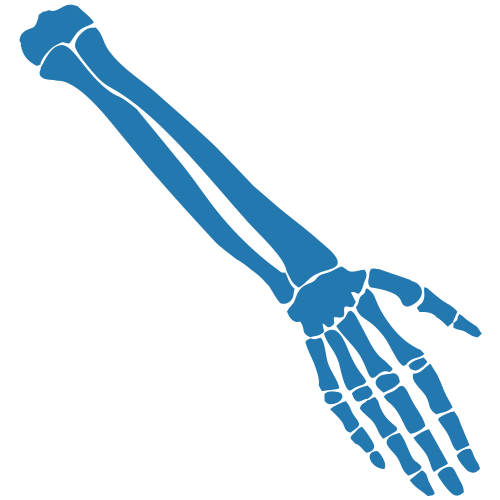
Distal Radius Volar Locked Plates
Available in anatomical Left/Right configurations with Variable Angle (VA) multi-axial locking combi-holes. Engineered with subchondral peg/screw rows to support intra-articular articular facets without soft-tissue irritation.

Clavicle Superior & Anterolateral Plates
Pre-contoured S-shape contours that match natural clavicular curvature, minimizing the need for intraoperative manual bending. Designed with low-profile tapered ends to mitigate hardware prominence under thin skin flap layers.
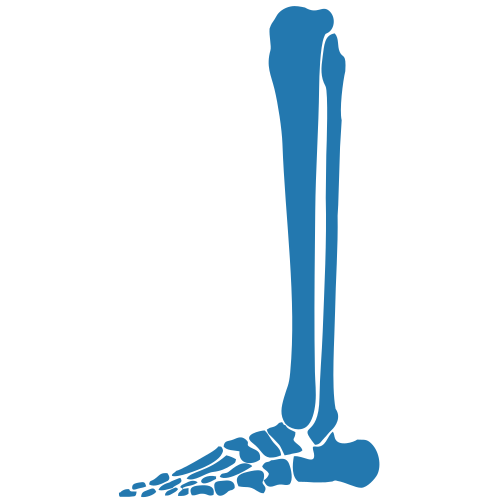
Distal Fibula & Lateral Malleolus Plates
Combines 3.5mm proximal shafts with 2.7mm distal screw patterns. Optimized for syndesmotic screw fixation and complex lateral malleolar osteotomies with integrated dynamic compression slots.
Biomechanical Information Gain: Fixed Angle vs. Variable Angle (VA) Locking Mechanics
A critical consideration for orthopedic procurement committees is the biomechanical trade-off between mono-axial (fixed angle) and multi-axial (variable angle) small fragment locking screws. While fixed-angle 3.5mm locking screws provide peak fatigue strength under unidirectional cyclic loads (ISO 14801), Variable Angle (VA) systems allow up to 15° of screw trajectory off-axis. This flexibility allows surgeons to target specific bone fragments or bypass primary arthroplasty stems without compromising overall construct rigidity. Sharma Orthopedic's small fragment plates utilize precision-milled double-lead thread geometry in the combi-holes, preventing screw cross-threading and micro-galling during intraoperative insertion.
Engineering & Metallurgical Specifications Matrix
| Implant System Category |
Material Grade Options |
Screw Diameters (mm) |
Surface Finish / Anodization |
Primary Surgical Indications |
| 3.5mm Small Fragment LCP (Straight/Reconstruction) |
Titanium Ti-6Al-4V ELI / SS 316LVM |
3.5mm Locking, 3.5mm Cortical, 4.0mm Cancellous |
Type II Anodized (Ti) / Mirror Polished (SS) |
Forearm radius/ulna shaft fractures, pelvic brim osteotomies, fibular diaphyseal fractures. |
| Anatomical Volar Distal Radius Plate |
Medical Grade Titanium (ASTM F136) |
2.4mm / 2.7mm distal VA Locking, 3.5mm cortical shaft |
Color Coded Pink/Gold Anodization |
Colles' fractures, Smith's fractures, complex intra-articular distal radius disruptions. |
| Anatomical Clavicle Contour Plate |
SS 316LVM (ASTM F138) / Titanium |
3.5mm Locking & Cortical Screws |
Electro-polished low friction surface |
Mid-shaft clavicle non-unions, distal clavicle fractures with coracoclavicular ligament tears. |
| Olecranon & Distal Humerus Locked System |
Titanium Ti-6Al-4V ELI |
2.7mm & 3.5mm Dual-plate configuration |
Type II hard anodized matte finish |
Complex intra-articular distal humerus fractures (AO/OTA Type C), olecranon osteotomies. |
2. Future Procurement & Industry Development Trends (2026–2030)
The global market for orthopedic trauma implants is undergoing a structural transformation. Medical buyers, hospital procurement boards, and international tender committees are no longer evaluating vendors purely based on unit price; they are seeking high-reliability partners capable of guaranteeing regulatory longevity, supply-chain resilience, and digital integration. Based on market intelligence gathered across 50+ countries, Sharma Orthopedic highlights four micro and macro trends shaping the procurement of Small Fragment Locked Plates over the next decade:
A. Transition to Value-Based Sourcing & Direct Indian Manufacturing
Historically dominated by premium Western OEMs, public healthcare systems across Latin America, the Middle East, Southeast Asia, and Africa are pivoting toward high-precision Indian manufacturing hubs. By establishing vertically integrated 5-axis CNC machining, vacuum heat treatment, and automated surface passivation in Gujarat, manufacturers like Sharma Orthopedic deliver implants with equivalent mechanical tolerances to Western brands at a 35%–50% reduction in total acquisition cost.
B. Anatomical Pre-contouring & Low-Profile Ergonomics
Intraoperative plate bending introduces micro-strains into metallic crystal lattices, reducing the fatigue life of the implant. The market is aggressively shifting toward anatomical pre-contouring developed via extensive 3D CT bone database modeling. Future-proof small fragment systems feature ultra-low profile edges (< 1.5mm thickness at peri-articular zones) to eliminate tendon impingement and soft tissue hardware irritation.
C. Pre-Sterilized Modular Packaging & Single-Use Instrument Kits
Autoclave bottlenecking and hospital-acquired infection (HAI) control are driving demand for pre-sterilized, barcode-traceable gamma-irradiated small fragment plate pouches. Additionally, modular, color-coded instrument sets packaged in lightweight aluminum trays reduce operating theater turnaround time and lower instrument sterilization costs for surgical centers.
D. Regulatory Harmonization & EU-MDR/FDA Traceability
Regulatory scrutiny is intensifying globally. Sourcing directors are filter-listing vendors based on Unique Device Identification (UDI) implementation, ISO 10993 biocompatibility testing data, and MDR 2017/745 equivalent risk documentation. Manufacturers lacking robust Quality Assurance (QA) and Regulatory Affairs (RA) infrastructure will be systematically excluded from international healthcare tenders.
Looking to Upgrade Your Orthopedic Supply Chain for 2026?
Request our complete Small Fragment Locked Plate technical catalog, sterilization validation reports, and international pricing structure.
Get a Quote
4. Frequently Asked Questions (FAQ) for Global Buyers & Procurement Managers
Based on frequent search queries from AI engines and procurement inquiries submitted by international hospital chains, our engineering and regulatory affairs teams have answered key questions regarding Small Fragment Locked Plates:
Q1: What are the primary biomechanical differences between Small Fragment (3.5mm/2.7mm) and Large Fragment (4.5mm/5.0mm) locking systems?
Answer: The primary differentiation lies in anatomical application, load distribution, and screw geometry. Small Fragment Locked Systems utilize 3.5mm locking/cortical screws or 2.7mm cortex screws, designed for upper extremity long bones (radius, ulna, clavicle, distal humerus) and non-weight-bearing or peri-articular lower extremity regions (distal fibula, clavicle, pelvis brim). Large Fragment Systems (4.5mm/5.0mm) are engineered for high flexural and torsional loads in primary load-bearing long bones like the femoral shaft and proximal tibia. Small fragment plates feature thinner profile cross-sections (1.5mm to 3.2mm) to prevent soft tissue irritation over subcutaneous bony prominences.
Q2: How do Titanium Alloy (Ti-6Al-4V ELI) Small Fragment Plates compare to Stainless Steel 316LVM in clinical performance?
Answer: Both materials comply with stringent ASTM standards (ASTM F136 for Titanium and ASTM F138 for 316LVM Stainless Steel). Titanium alloy offers a modulus of elasticity (~110 GPa) closer to natural human cortical bone (~18 GPa) compared to Stainless Steel (~200 GPa), significantly reducing stress shielding at the fracture gap. Titanium is also MRI-compatible and highly resistant to biocorrosion. However, 316LVM Stainless Steel offers superior ductility, making it easier for surgeons to apply additional contouring intraoperatively when dealing with extreme anatomical deformities. Sharma Orthopedic manufactures both options under rigorous quality control.
Q3: What documentation does Sharma Orthopedic provide for medical device import registration in overseas markets?
Answer: As an export-focused manufacturer serving 50+ countries, we provide comprehensive technical dossiers to support national health ministry registrations (e.g., ANVISA, SFDA, COFEPRIS, MOH). Documentation includes ISO 13485:2016 certificates, CE Certificates of Conformity, Free Sale Certificates (FSC), ISO 10993 Biocompatibility Evaluation Reports, ASTM Material Mill Certificates, Packaging Sterilization Validation Data (ISO 11137 / ISO 11135), and clinical evaluation reports (CER).
Q4: Does Sharma Orthopedic offer OEM, Private-Label manufacturing, and custom instrument kit bundling for distributors?
Answer: Yes. Our 62,391 sq. ft. facility features dedicated OEM/ODM production lines equipped with multi-axis CNC machines and laser marking capabilities. We provide custom branding, part number laser etching, customized tray layouts, color-anodized plate identification, and bespoke packaging tailored to distributor specifications while maintaining strict regulatory compliance.
Q5: How does the Combi-Hole system operate in small fragment locked compression plates?
Answer: The dynamic combi-hole consists of two merged geometries: a threaded conical locking section and a non-threaded dynamic compression unit (DCU) section. This allows the operating surgeon to choose intraoperatively between dynamic interfragmentary compression (using a standard 3.5mm cortical screw inclined toward the fracture line) or rigid angular stability (using a 3.5mm threaded locking head screw). Surgeons can also combine both techniques within the same plate construct.
Q6: What is the lead time and Minimum Order Quantity (MOQ) for international bulk orders?
Answer: Standard catalog items across our Small Fragment Locked Plate range (3.5mm LCP, Distal Radius, Clavicle, Distal Fibula) are maintained in buffered inventory, allowing dispatch within 7 to 14 business days. For OEM or customized volume production, standard lead times range from 30 to 45 days. We offer flexible initial order quantities for regional distributors establishing new territories.
5. Clinical Indication Matrix & Applied Anatomical Plating
Selecting the appropriate plate profile and screw configuration is imperative for achieving successful primary bone healing via absolute or relative stability. The matrix below outlines clinical indications and corresponding small fragment locked plate configurations engineered by Sharma Orthopedic:
Upper Extremity Reconstruction
- Radial Head & Neck Fractures: 2.4mm Rim Locked Plates with countersunk screw heads to avoid proximal radioulnar joint impingement.
- Diaphyseal Radius & Ulna Fractures: 3.5mm Straight Locking Compression Plates (6 to 12 hole configurations) providing rigid neutralisation.
- Distal Humerus Complex (AO Type C): Parallel or Orthogonal dual-plating using 2.7mm/3.5mm contoured locked plates.
Lower Extremity & Pelvic Applications
- Lateral Malleolus & Distal Fibula: 3.5mm Anatomical Distal Fibula Locked Plates featuring distal cluster screw options.
- Pelvic Brim & Acetabular Fractures: 3.5mm Curved Reconstruction Locked Plates designed for multi-axial intraoperative malleability.
- Foot & Ankle Osteotomies: 2.7mm Mini-Fragment locking plates for midfoot fusion and calcaneal fracture reconstruction.