
An authoritative, data-driven analysis for hospital procurement officers, orthopedic distributors, and surgical directors. Learn how modular external fixators, Ilizarov circular frames, and radiolucent carbon fiber systems optimize strain dynamics, reduce pin-site infection rates, and deliver clinical efficiency across acute trauma and limb reconstruction.
External Fixator Systems represent a critical arm of damage-control orthopedics (DCO) and complex limb reconstruction. Unlike internal fixation plates or intramedullary interlocking nails, external fixation constructs operate outside the anatomical envelope, transmitting structural loads across bony fragments through transfixion pins, Schanz screws, and interconnecting rods or rings.
Global procurement teams must evaluate external fixators not merely as emergency stabilization kits, but as precision mechanical assemblies capable of dynamic axial compression, distraction osteogenesis, and multi-planar deformity correction. The clinical choice of frame configuration directly impacts callus formation through the mechanical strain environment at the fracture zone.
Interfragmentary strain ($\varepsilon = \Delta l / l$) governs tissue differentiation. Optimal bone healing requires a mechanical stiffness gradient that allows 2% to 10% axial strain. High-grade external fixators produced by Sharma Orthopedic offer controlled elasticity, protecting against stress shielding while maintaining rigid rotational and bending stability.

From high-energy open tibial shaft fractures to complex pelvic ring disruptions, Sharma Orthopedic manufactures dedicated frame modules designed for precise anatomical alignment.
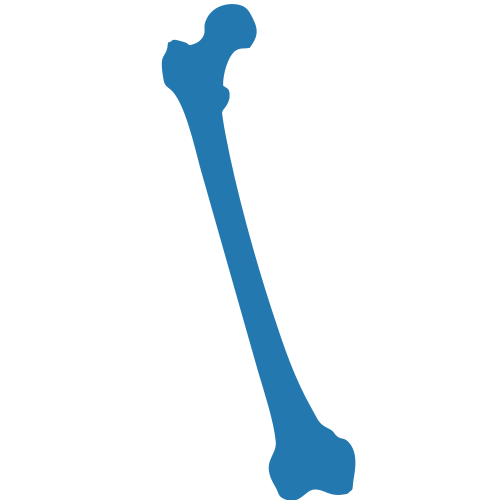 Femural Fixators
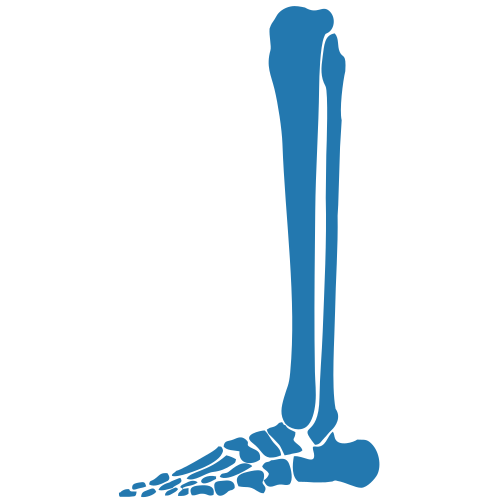 Tibia / Fibula
 Pelvic Ring
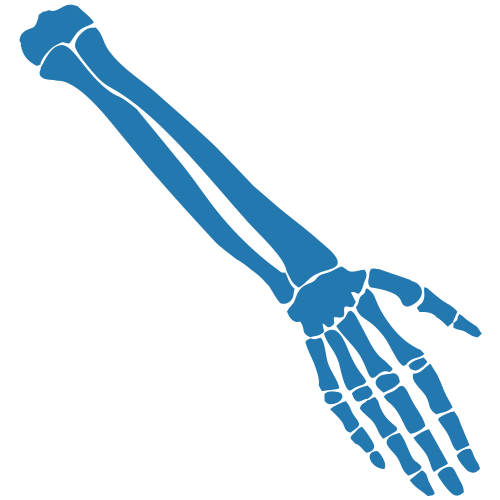 Radius / Wrist
 Humerus
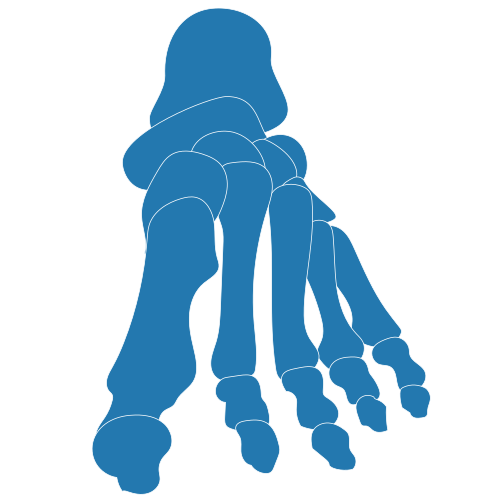 Foot & Ankle
To meet divergent surgical preferences and budget constraints across global markets, Sharma Orthopedic provides four primary external fixator structural categories. Each system is manufactured in Vadodara, Gujarat under strict ISO 13485 quality control.
Engineered for long-bone fractures, limb lengthening, and non-union correction. Features a rigid central telescopic body with built-in dynamic axialization modules that allow controlled micro-motion during late-stage callus formation.
The gold standard in complex deformity correction and limb reconstruction. Utilizes full, 2/3, and 5/8 rings constructed from high-strength carbon fiber or stainless steel, tensioned via transfixion Kirschner wires (1.5mm to 2.0mm).
Designed for fast-track trauma resuscitation and temporary damage-control fixations. Allows surgical teams to build custom rod-to-rod and pin-to-rod bridge constructs around severe open joints and comminuted fractures within minutes.
Tailored specifically for upper extremity trauma, distal radius intra-articular fractures, and pediatric metacarpal osteosynthesis where low-profile hardware is non-negotiable.
Procurement managers can review standardized technical parameters below to cross-reference tender specifications and regulatory requirements:
| System Category | Material Standard | Tensile Strength (MPa) | Radiolucency Level | Sterilization Protocol | Regulatory Compliance |
|---|---|---|---|---|---|
| Monolateral Heavy Duty | Ti-6Al-4V (ASTM F136) / SS 316LVM | ≥ 860 MPa | Partial (Rods Radiolucent) | Autoclave 134°C (Steam) | ISO 13485, CE, CDSCO |
| Ilizarov Ring Fixator | Carbon-PEEK Composite / Steel 316L | ≥ 1200 MPa (Carbon) | High (Zero Artifacts on X-Ray) | Autoclave / Gamma Sterilization | ISO 13485, CE Marked |
| Modular Trauma Span | Carbon Fiber Rod (11mm) + Al Clamps | ≥ 950 MPa | Complete Rod Radiotranslucency | Autoclave 134°C (Steam) | ISO 13485, CE Approved |
| HA-Coated Schanz Pins | Biocompatible HA on Titanium / SS | Bond Strength > 15 MPa | Radiopaque for Pin Depth Check | Gamma Irradiated / Sterile Pack | ISO 13485, CE, Cleanroom 10k |
The global external fixators market is projected to reach over USD 1.8 Billion by 2030, driven by an aging global population, surging road traffic accidents in developing economies, and rapid advancements in orthobiologics. Hospital purchasing boards must align their supply chains with key technological shifts:
Traditional metallic frames create significant radiopaque scatter on intraoperative C-arm fluoroscopy and postoperative CT/MRI scans. The industry wide transition toward structural Carbon-Fiber-Reinforced PEEK rings and rods allows unhindered 3D visualization of callus bridge formation without frame disassembly.
Pin-site infection remains the single biggest complication in external fixation, occurring in up to 30% of long-term frames. Future-ready purchasing focuses on Hydroxyapatite (HA) plasma-sprayed Schanz screws and silver-nanoparticle anti-microbial coatings that promote osteointegration at the pin-skin interface while suppressing biofilm formation.
Deformity correction is shifting rapidly from manual trigonometric calculations to web-based computer software hexapod systems. Surgeons input radiographic parameters into 3D navigation suites, receiving daily strut adjustment prescriptions for precise six-axis deformity correction (translation, rotation, angulation, and lengthening).
Global medical device procurement is moving away from high-markup regional intermediaries toward certified OEM/ODM original manufacturers in India. High inflation and healthcare budget squeezes in Europe, Latin America, and Southeast Asia make direct sourcing from accredited Indian facilities—which offer up to 40% cost efficiency without compromising ISO or CE quality standards—a top strategic imperative for hospital networks.
Founded in 1992, Sharma Orthopedic India Limited has established itself as an international benchmark in orthopedic implant engineering. Operating out of our expansive 62,391 sq. ft. campus in Waghodia, Vadodara, Gujarat, we combine advanced German-machining technologies with strict regulatory governance.
Addressing top questions submitted by global medical distributors, hospital purchasing committees, and biomedical engineers.
Our external fixator components utilize medical-grade materials adhering strictly to international standards: Titanium Alloy Ti-6Al-4V ELI (ASTM F136 / ISO 5832-3) for low-weight high-strength pins and clamps; Cold-Worked Stainless Steel 316LVM (ASTM F138 / ISO 5832-1) for high-rigidity structural elements; and high-modulus radiolucent Structural Carbon Fiber Composites for connecting rods and Ilizarov rings. All raw materials are sourced with full mill test certs and heat-number traceability.
Plasma-sprayed Hydroxyapatite (HA) coated Schanz pins create a direct chemical bond (osteointegration) with host bone tissue. Clinical studies demonstrate that HA-coated pins require significantly higher extraction torque values compared to uncoated stainless steel pins after long-term implantation (6+ weeks). This dramatically decreases micro-motion, prevents pin-track sepsis, reduces pin looseness by up to 75%, and minimizes early frame removal rates.
Yes. Sharma Orthopedic manufactures external fixators according to standardized metric modular dimensions. Our 11.0mm rod systems, pin-to-rod clamps, T-handles, torque-limiting wrenches, and wire tensioners use universal connections compatible with international AO-type standard sets. We also provide customized OEM instrumentation trays designed for swift intraoperative assembly.
For every export order, Sharma Orthopedic provides a complete regulatory tender dossier. This includes: ISO 13485:2016 Quality Certificate, CE Certificate of Conformity, Free Sale Certificates (FSC), Certificate of Analysis (CoA) for raw materials, Biocompatibility Test Reports (ISO 10993), Gamma/Steam Sterilization Validation Protocol, and detailed Surgical Technique Guides.
Carbon fiber rods can be ordered in pre-cut lengths ranging from 100mm to 450mm. While carbon rods should ideally not be cut intraoperatively due to composite fiber delamination risks, our stainless steel and aluminum rods can be trimmed using high-speed rod cutters included in our surgical instrument sets, provided all cut ends are deburred before sterile field placement.
Standard SKU orders (such as modular trauma fixator sets and standard Ilizarov ring sizes) are maintained in buffer stock and can be dispatched within 7 to 10 working days via air freight or sea container shipment. Custom OEM manufacturing orders or large ministry tender volumes typically require a 30 to 45 day lead time, including cleanroom packaging and final quality audits.
"The modular pin-to-rod external fixators from Sharma Orthopedic have streamlined our emergency damage-control trauma protocols. The carbon fiber rods provide crystal-clear intraoperative fluoroscopy, and the clamps maintain rock-solid rigidity even during patient transport."
"As a long-term distributor, we rely on Sharma Orthopedic for consistent ISO 13485 manufacturing quality. Their Ilizarov ring system and HA-coated Schanz pins have received unanimous praise from reconstructive surgeons across our hospital network."
Connect directly with our international export department in Vadodara, India for pricing, tender documentation, and OEM opportunities.