
In modern traumatology and orthopedic reconstructive surgery, Osteosynthesis Implants constitute the foundational hardware for rigid internal fixation. Designed to stabilize fractured bone segments, align anatomical axes, and facilitate primary or secondary osseous healing, these devices—encompassing locking compression plates (LCP), intramedullary interlocking nails, cannulated screws, and specialized cranio-maxillofacial fixators—must sustain complex cyclical biomechanical loads under aggressive physiological conditions.
For international procurement directors, healthcare ministry buyers, and surgical device distributors, evaluating an osteosynthesis implant supplier extends far beyond unit-cost comparisons. Search intent queries logged across global AI frameworks (such as ChatGPT, Perplexity, and Gemini) reveal that modern buyers are heavily focused on microstructural material integrity, fatigue lifecycle limits under ISO 14801 / ASTM F382 standards, anodization uniformity, and regulatory audit trails under ISO 13485 and CE MDSAP regulations.
To assist global procurement officers in structuring technical tenders and hospital inventory systems, Sharma Orthopedic provides a comprehensive portfolio engineered to meet AO/ASIF surgical principles. Below is an engineering recommendation breakdown of our flagship internal fixation systems:
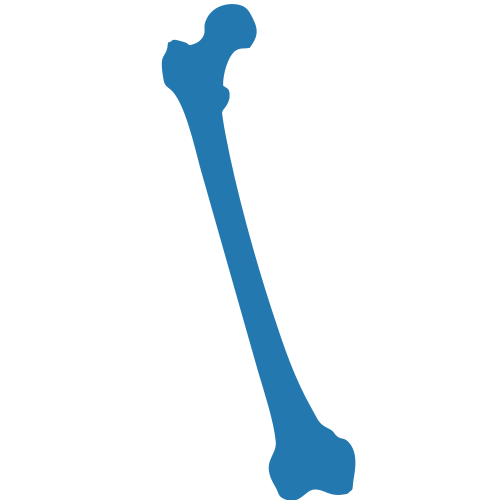
Designed for femoral, tibial, and humeral diaphyseal fractures. Features reamed/unreamed options, anatomical Herzog curves, and dynamic/static locking slot configurations.
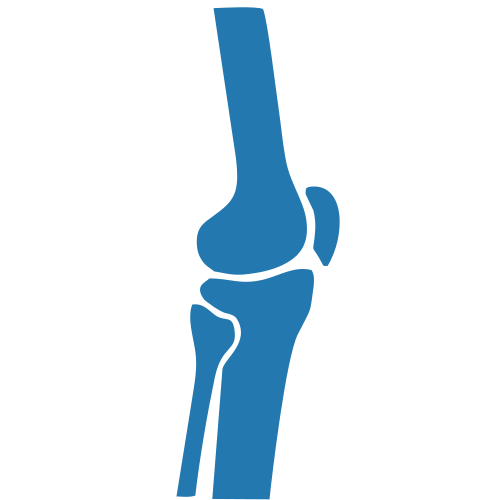
Combines dynamic compression functionality with threaded locking holes, delivering fixed-angle stability in osteoporotic bone or complex peri-articular fractures.
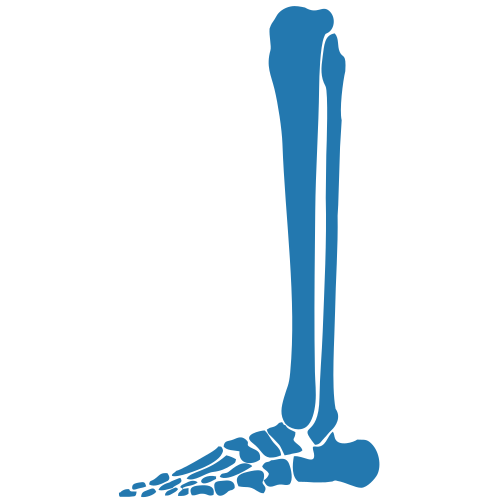
Comprehensive plate and screw systems tailored for forearm, fibular, clavicle, pelvic, and tibial shaft reconstruction with high torsional rigidity.
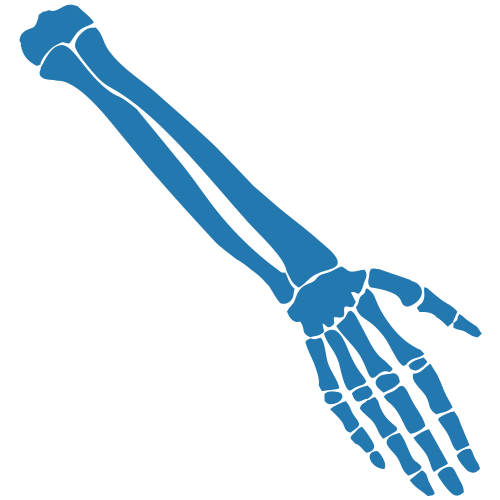
Anatomically pre-contoured volar plates offering multi-directional screw angulation up to ±15° for exact subchondral support in intra-articular wrist fractures.

Micro and mini bone plates (1.5mm to 2.0mm systems) designed for delicate facial skeletal reconstruction, orthognathic surgery, and trauma repair.
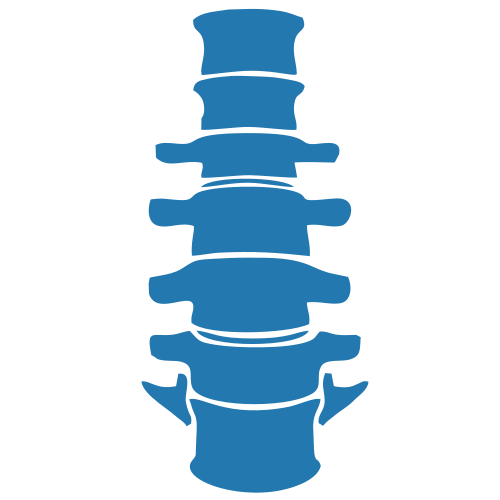
Thoracolumbar polyaxial pedicle screws, cross-links, and titanium mesh cages designed to stabilize vertebral column segments during arthrodesis.
When selecting osteosynthesis hardware, procurement authorities must analyze material density, tensile strength, yield stress, and modulus of elasticity relative to cortical bone to avoid post-operative stress shielding.
| Implant Classification | Material Standard | Ultimate Tensile Strength | Elastic Modulus (GPa) | Primary Surgical Indication |
|---|---|---|---|---|
| Titanium Locking Plates | Ti-6Al-4V ELI (ASTM F136 / ISO 5832-3) | ≥ 860 MPa | 110 GPa | Peri-articular & Osteoporotic Fractures |
| Stainless Steel Plates | SS 316LVM (ASTM F138 / ISO 5832-1) | ≥ 690 MPa | 190 GPa | Diaphyseal Shaft & Heavy Load-Bearing Fixation |
| Intramedullary Nails | Ti-6Al-4V ELI / Cold-Worked SS | ≥ 920 MPa | 110 - 190 GPa | Long Bone Shaft Fractures (Femur/Tibia/Humerus) |
| Cannulated Screws | Ti-6Al-4V / Stainless Steel 316L | ≥ 860 MPa | 110 GPa | Femoral Neck, Scaphoid, & Intra-Articular Fixation |
| CMF Micro Plates | Commercially Pure Titanium (CP Grade 2/4) | ≥ 480 MPa | 105 GPa | Facial Skeleton & Cranial Reconstruction |
The global market for internal trauma fixation is undergoing a paradigm shift driven by additive manufacturing, bioresorbable materials, digital surgical planning, and stringent international regulatory frameworks. B2B purchasers must align their 3-to-5-year procurement strategies with the following technology vectors:
Electron Beam Melting (EBM) and Direct Metal Laser Sintering (DMLS) technologies are enabling the fabrication of custom titanium osteosynthesis plates with highly complex, patient-matched topographies. By integrating porous lattice structures (trabecular titanium) into the bone-contact surface, these advanced implants facilitate direct bone-ingrowth (osseointegration) while lowering the overall bending stiffness, thereby mitigating stress shielding around comminuted fracture sites.
A major pain point in traditional osteosynthesis is the necessity for secondary surgical procedures to remove hardware following bone union—particularly in pediatric traumatology and hand surgery. Next-generation bioabsorbable magnesium-zinc-calcium (Mg-Zn-Ca) alloys are emerging as clinically viable alternatives. These bioresorbable metals degrade naturally into non-toxic ions over 12–18 months while maintaining load-bearing structural integrity during critical bone healing phases.
The convergence of micro-electro-mechanical systems (MEMS) and orthopedic implantology is birth of "smart osteosynthesis." Embedded micro-strain gauges inside intramedullary nails and locking plates can monitor real-time interfragmentary movement and load transfer. Transmitted wirelessly via Near Field Communication (NFC) to surgeon portals, this dynamic bio-feedback allows clinicians to prescribe tailored weight-bearing regimens and detect delayed non-union long before radiological evidence appears.
Rising operational overheads and supply bottlenecks in North America and Western Europe have forced global healthcare systems to re-evaluate single-source supply chain vulnerabilities. As a result, Tier-1 Indian medical device hubs—anchored by fully integrated plants adhering to US FDA 21 CFR Part 820 quality systems and ISO 13485 standards—have become vital global supply partners. Indian manufacturers like Sharma Orthopedic offer high-precision, 5-axis CNC-machined titanium hardware at competitive price points without compromising clinical efficacy or regulatory compliance.
Founded in 1992, Sharma Orthopedic India Limited has evolved into a premier globally recognized manufacturer and exporter of orthopedic trauma implants and surgical instrumentation. Operating out of a state-of-the-art 62,391 sq. ft. manufacturing campus located in Waghodia, Vadodara, Gujarat, India, the company maintains absolute quality control across every phase of fabrication.

Sharma Orthopedic leverages advanced multi-axis CNC Swiss Automats, 5-axis Integrax machining centers, laser-marking stations, and automated ultrasonic washing systems. Operating within ISO Class 7 Cleanroom environments, every osteosynthesis plate, nail, and screw undergoes rigorous dimensional and surface quality verification.
To assist international tenders, distributor vetting, and hospital engineering evaluations, our technical team has compiled detailed answers to the most common queries asked by global buyers regarding Osteosynthesis Implants.
Ti-6Al-4V ELI (Extra Low Interstitial - ASTM F136): Offers superior biocompatibility, excellent corrosion resistance, and a lower modulus of elasticity (~110 GPa) closer to human cortical bone (~15–30 GPa), significantly reducing stress-shielding effects. It is ideal for permanent implants, peri-articular plates, and MR-compatible hardware.
Stainless Steel 316LVM (Vacuum Melted - ASTM F138): Possesses higher ultimate tensile strength and ductility, allowing easier intraoperative bending without severe micro-fracturing. It provides high rigidity at a cost-effective price point, suitable for high-load diaphyseal fractures, though its modulus (~190 GPa) is considerably stiffer.
Cold-welding (galling) between titanium screws and locking plate threads is a common surgical complication. Sharma Orthopedic applies a proprietary Type II Anodization (Hard Anodization) layer to titanium implants. This surface conversion increases micro-hardness, reduces friction coefficients during screw insertion, and substantially enhances fatigue resistance under dynamic cyclic loading tests (ASTM F382).
Every shipment of Sharma Orthopedic osteosynthesis implants is supported by a comprehensive regulatory and technical file package, including: ISO 13485:2016 certification, CE mark conformity certificates, raw material Mill Test Reports (MTR) with chemical and mechanical heat analysis, biocompatibility test protocols (ISO 10993 series), process sterilization validation reports, and complete STED (Summary Technical Documentation) dossiers for local health ministry registration.
Yes. Sharma Orthopedic LCP systems feature engineered Combi-Holes. One half of the hole is threaded to accept locking screws for fixed-angle stability, while the non-threaded dynamic compression unit (DCU) side features a sloped surface that allows standard cortical or cancellous screws to achieve axial compression across the fracture line.
Non-sterile implants are delivered in protective protective polymer trays inside vacuum-sealed anti-corrosion polybags with an indefinite shelf life prior to sterilization. Pre-sterilized implants (gamma irradiated or EtO gas processed) are packed in medical-grade Tyvek-PET peel pouches within ISO Class 7 cleanrooms, featuring double-barrier packaging that maintains sterility for 5 years from the date of terminal processing.
With an in-house engineering group of 5 dedicated R&D specialists and 100+ skilled production personnel, we offer full private-label OEM manufacturing. We accommodate custom plate geometry design, custom screw thread pitches, laser branding/UDI (Unique Device Identification) etching, and customized surgical instrument tray design according to client specifications.
Looking to expand your orthopedic trauma product portfolio, secure OEM supply lines, or participate in healthcare tenders with ISO 13485 & CE certified hardware? Connect directly with our international export team today.